Begin below the stone
A table that appears stationary is still part of a building. Its legs bear on a floor that may flex, compress a covering or respond to changes in loading. A new installation therefore begins with the supporting conditions, not with a ball placed on the finished cloth. The installer needs a stable arrangement in which the frame can carry the slate without rocking or twisting.
Carpet and underlay deserve particular attention because their compression can change the support relationship after installation. That does not mean a carpeted room is unsuitable. It means the installer should choose appropriate bearing arrangements and explain when a follow-up check is sensible. Where floor capacity is uncertain, obtain a structural assessment. A spirit level cannot tell an owner whether joists are adequate for the total load.
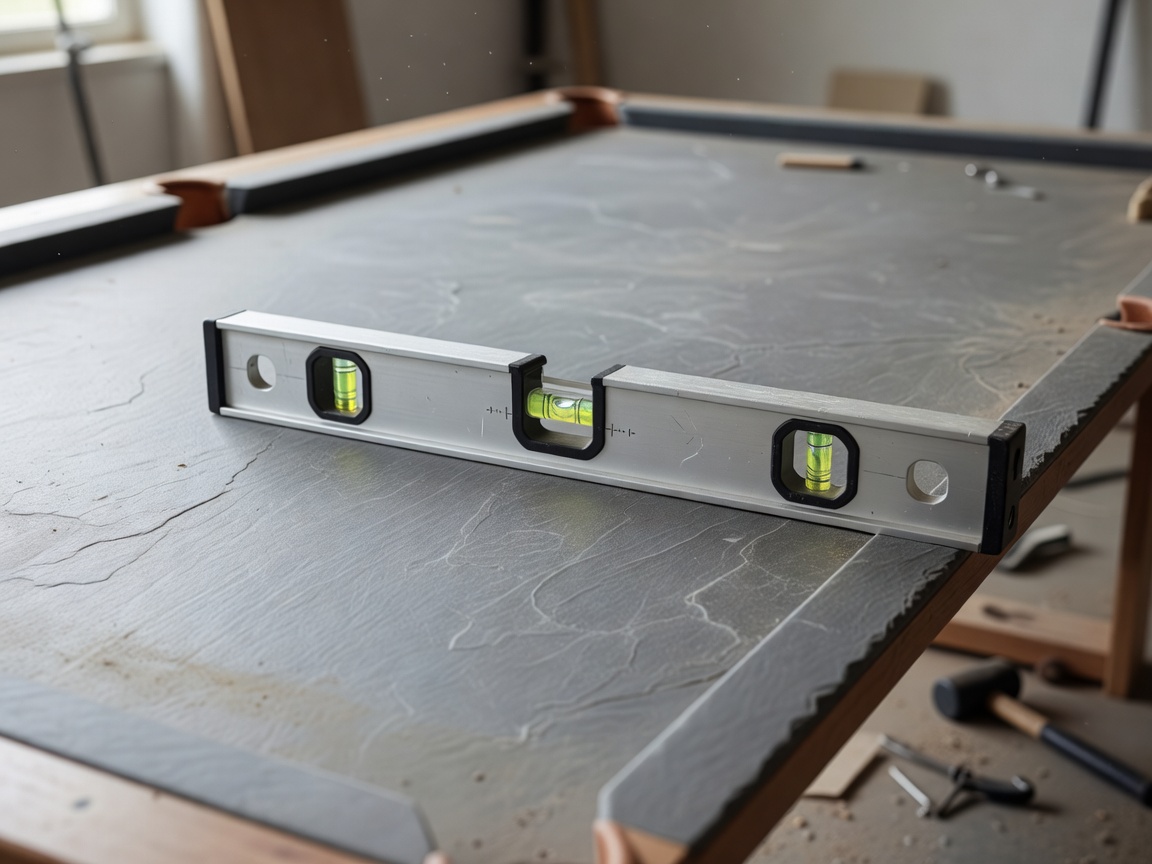
Separate three questions
First ask whether the supporting assembly is level in its main directions. Then ask whether the slate surface is locally flat, including across section joints. Finally ask whether the covered table plays consistently. These questions overlap, but none replaces the others. A single level reading in the centre can miss a corner problem; a straightedge can reveal a ridge without establishing the whole bed’s relationship to gravity.
A suitable precision level is more sensitive than many general building levels, which also makes handling and interpretation more important. Clean the contact surface, allow the instrument to settle and check its calibration according to the manufacturer’s instructions. Reversing the instrument at the same location is a common way to investigate zero error. Starrett and STABILA publish instrument information, but the correct choice depends on sensitivity, contact geometry and the installation method rather than the name alone.
Work from frame to seams
A typical sectional-bed installation establishes the supporting frame first, then brings the slate sections into a shared plane. The exact order of fixing, adjustment and joint finishing is specific to the table and installer’s method. The important principle is that an adjustment at one support can alter readings elsewhere. The work is iterative: measure, make a controlled correction and recheck the affected directions rather than chasing isolated bubbles.
Seams need particular care because two individually level pieces can still meet at different heights. Fillers should finish a properly aligned joint, not act as a structural bridge or conceal a large step. Avoid generic advice to add household wedges wherever a ball drifts. Unsuitable material can compress or concentrate loads, and an uncontrolled lift can damage the slate. Owners should not loosen bed fixings or attempt to lift an assembled table to experiment.
Diagnose the roll before adjusting
After covering, slow test rolls can help reveal the playing response, but they are not pure measurements of level. A ball may be dirty, damaged or out of round. Cloth can have a directional nap, uneven tension, debris or wear. A hand release may introduce spin. Repeat observations from several positions and in opposing directions, using clean, sound balls, before deciding that the supporting plane is the cause.
In snooker, cloth direction is a particularly important part of that diagnosis. Consult the cloth maker’s care guidance rather than importing a pool-cloth routine. Hainsworth and Iwan Simonis describe different products and maintenance practices; those instructions should be read for the exact cloth fitted. A consistent directional effect may point toward surface behaviour, while a local deviation can justify inspecting a seam or worn patch. Neither observation alone establishes a repair.
Climate and movement also belong in the record. Changes in relative humidity can affect wooden components, and any relocation changes the relationship between the table and floor. There is no universal calendar interval that makes sense for every building and installation. Arrange a check after moving, after noticeable settling or when a repeatable playing change appears. Photographing the relevant location and describing the direction of drift gives an installer a better starting point than a general complaint about speed.
Good leveling is deliberately uneventful once complete. It should leave the owner with a table that behaves consistently and an understanding of what not to disturb. The frame is the next part of the explanation: unless its connections hold their geometry under load, careful adjustments have an unstable foundation.